Having shelf-stable food on hand is important for emergency preparedness, budget management, and daily convenience. If you use a macronutrient approach to menu planning, it is possible to have a pantry stocked with staples that will provide the nutrition you need for $7 a day or less.
Spend a dollar to save hundreds over time
My pantry list costs just $1, which may well save you hundreds of dollars over time. Try it out as it is, or modify it to suit your own needs.
Please note, I have no food allergies. However, I have made the list as gluten-free, non-GMO, and as organic as possible within the budget.

It’s OK to restrict calories
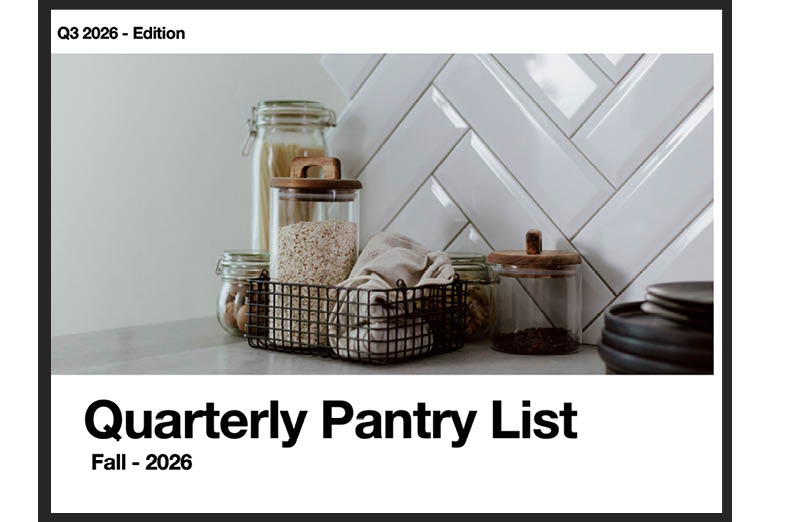
The Menu Plan Cook Quarterly Pantry List is based on 1600 calories per day. Depending on your physical activity, you can generally get along on 20 percent less than the average daily requirement of 2,000 calories set by the Department of Health and Human Services according to the National Academy of Medicine, which sets Dietary Reference Intakes (DRIs).
If you are Erling Haaland you need 6,000 calories a day, but you’re probably not playing in the World Cup soccer finals.
Research at the National Institutes of Health is even more supportive that a moderate calorie reduction — such as 20 percent — can be beneficial for muscle health, metabolic function, and healthy aging, provided it’s done in a balanced, sustainable way, according to the National Institute on Aging.
The intention at Menu Plan Cook is to give you what you need to survive. If you can survive and also thrive on restricted calories, that’s even better. Calorie restriction is not forever—just until the crisis passes.
Macronutrient Menu Planing
The Quarterly Pantry list is based on macronutrient menu planning, the approach professional dietary managers use. Here are the building blocks of macronutrient menu planning:
- The diagram below illustrates the ratios of carbohydrates, fats, and protein in my own long-term menu plan. National Academy of Medicine range recommendations are provided in the caption boxes. As you can see, my diet falls comfortably within all recommended ranges: 50% carbohydrates, 18% fats, and 32% protein.
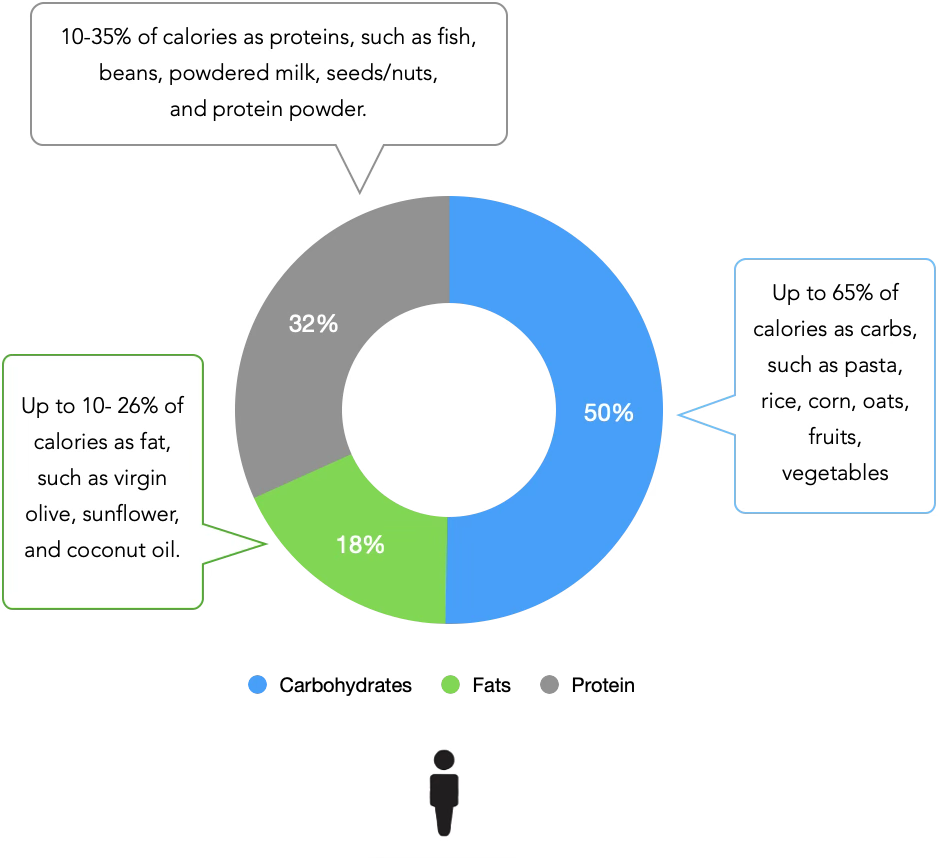
If you want to be more precise for your own nutritional needs, the National Academy of Medicine provides on their website the DRI calculator used by dietary professionals.
DRI Calculator for Professionals
What are the most nutrient-dense macronutrients?
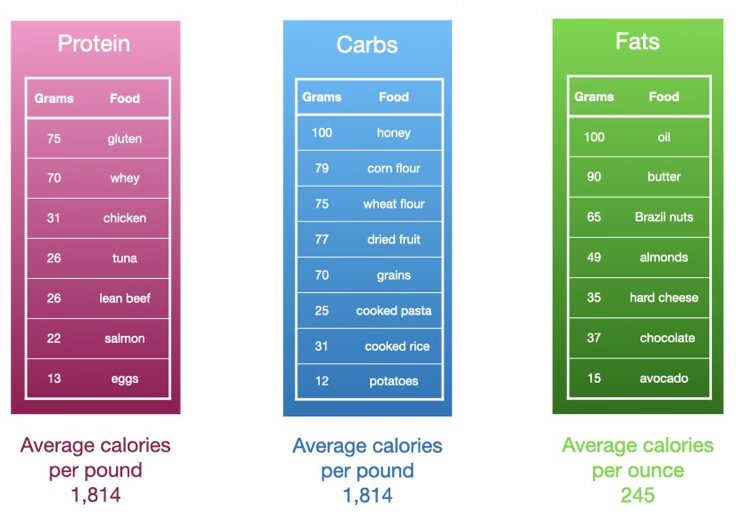
- Below are listed the nutrient-dense macronutrients in descending order of concentration. Make sure you are eating some foods from each group.
How to build your own pantry list
- Given 1600 calories as a target daily intake, your goal is to consume 48,000 calories each month (1600 X 30). The captions show the average number of calories per pound (or ounce, in the case of fats) for each macronutrient.
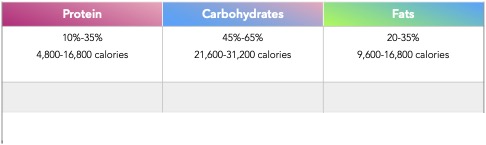
Say you are aiming for 18,140 calories of carbohydrates (1,814 X 10) to meet the ratio recommended in your diet for three months (one quarter). That means you will want to shop for 10 pounds of carbohydrates (because there are 1,814 calories per pound, on average, in the carbohydrate group). Your grocery list could pencil in 4 pounds of pasta, 4 pounds of rice, and 2 pounds of oatmeal to meet 10 pounds of carbohydrates. Do the same for the other macronutrient groups.
Find a balance in your menu planning
My menu plan gives you a rough estimate of what you should stock in your pantry. Few foods are purely one macronutrient or another. For example, there is a carryover of protein from the grains and pulses in the carbohydrate group, from about 6% for rice, up to 17% for oats, to 24% for red lentils.
One compromise I personally do not make when I’m grocery shopping is the quality of fats. The oils I stock are virgin, cold-pressed, and mostly organic, making them the most expensive oils you can buy. I compromise somewhat on carbohydrates because not all of them are organic or non-GMO or gluten-free, but many are. I can afford this kind of quality on about $7 a day, and so can you.
You need to decide on your own ratio of macronutrients, your own compromises and priorities, and develop your food pantry list from there.
The food budget works out to about $7.03 a day based on 1600 calories. I update my pantry list quarterly and track price trends…just checking on the Cost of Living Index.
How to know you are getting the nutrition you need
The U.S. Department of Agriculture provides nutritional statistics to the public. Food Data Central is a database they maintain where you can look up the nutritional content of the food you are eating. https://fdc.nal.usda.gov/ Macronutrient menu planning provides the macronutrients you need. However, there is another half to the story: micronutrients. Food Data Central can help you determine if you are getting the micronutrients you need. If there’s a shortfall, you should consider taking a multivitamin. It is important to note that if you live exclusively on packaged goods, you will become deficient in vitamin C and the B vitamins. I compensate for this in my Quarterly Pantry List with addition of Emergen-C and brewer’s yeast. You can live on pantry staples over the long term, but please note the Surgeon General does not advise eating meals ready-to-eat (MREs) for more than 21 days.